NeuroMotion Odd/Even: Divided Attention for Athletics
In athletics, the sprinter must manage the start, running technique and race strategy simultaneously. NeuroMotion Odd/Even trains divided attention.
Divided attention, the challenge of athletics
In athletics, the sprinter must manage the start, running technique and race strategy simultaneously. The jumper must count approach steps while adjusting speed. This divided attention — managing movement AND counting at the same time — is what distinguishes the regular athlete from the complete athlete.
NeuroMotion Odd/Even (Pair/Impair) is the Mindtrain exercise that trains this divided attention: memorizing, counting Odd/Even, then recalling.
Why divided attention is decisive in athletics
- Sprint: manage the start, arm frequency and strategy
- Jump: count approach steps while adjusting speed
- Throw: coordinate technique and trajectory
An athlete with poor divided attention loses track of their counting or technique under effort.
How NeuroMotion Odd/Even trains this skill
The exercise unfolds in 3 phases: memorize items, count Odd/Even during interference, then recall. Two modes:
- Screen Mode: interference and memorization on the device
- Field Mode: physical running to cones with interference rules
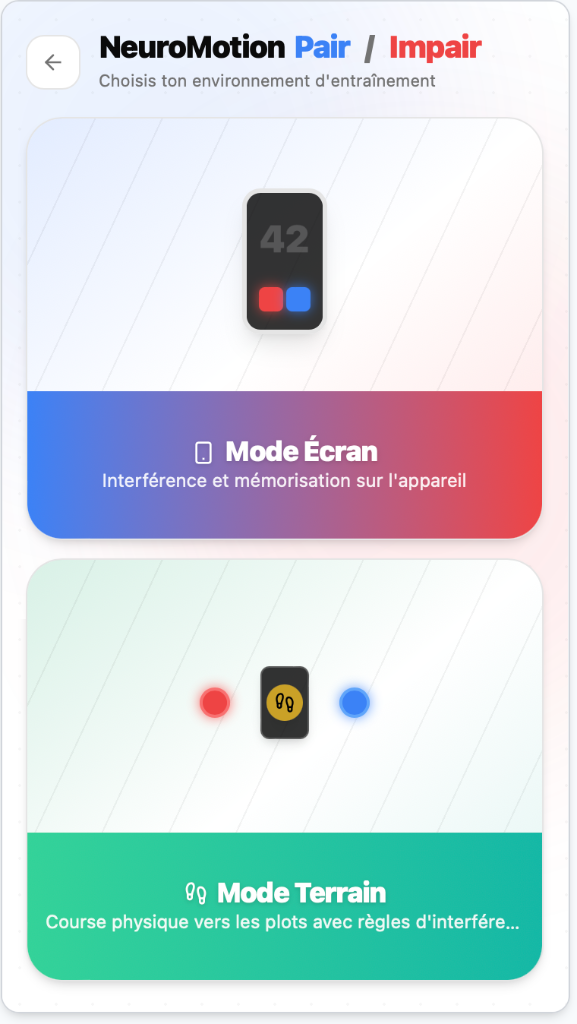
Mode selection: Screen (interference) or Field (physical running to cones).
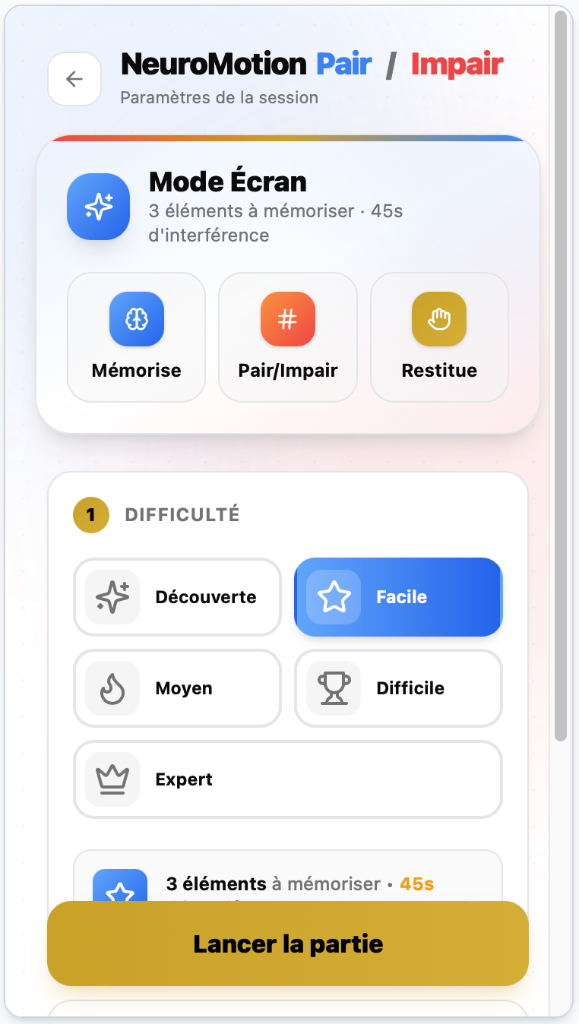
Memorize, count Odd/Even, then recall — the cognitive-motor dual task in 3 phases.
Field equipment to complement training
The motor skills mat and targets reproduce athletics movements.
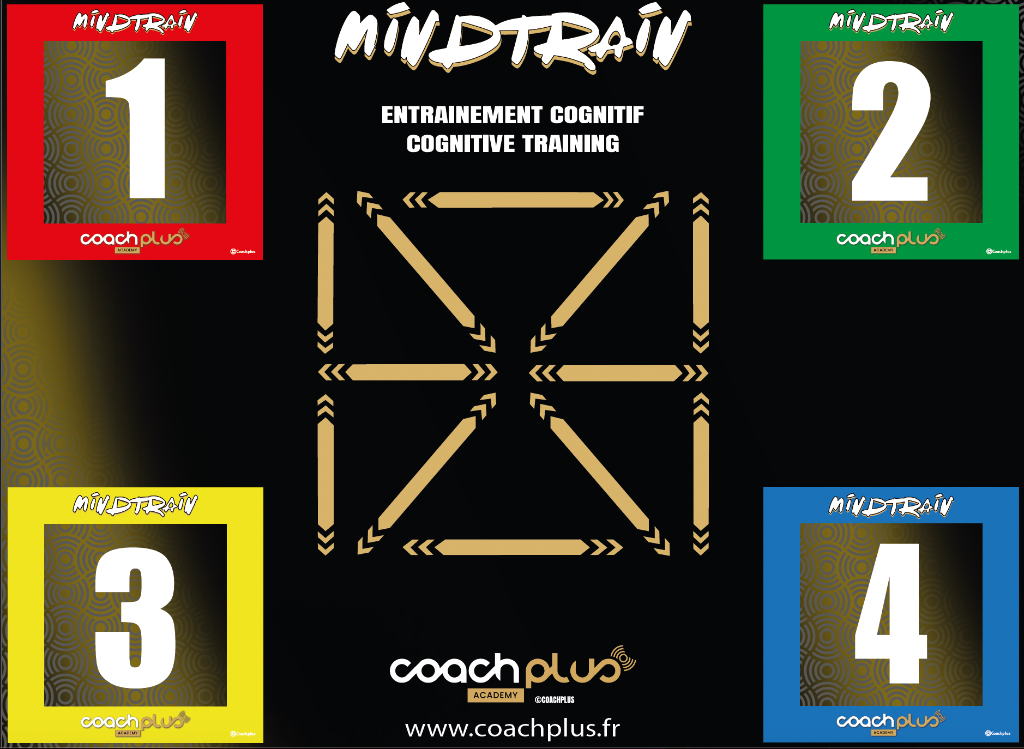
The motor skills mat — to train divided attention in motion.
The science behind divided attention
- Divided attention is a predictor of performance in technical sports.
- Dual task (movement + counting) simulates the cognitive load of competition.
- Divided attention training improves attentional robustness under effort.
Mindtrain is a training tool. For a comprehensive cognitive assessment, consult a sports neuropsychologist.
Frequently asked questions
What does NeuroMotion Odd/Even train?
NeuroMotion Odd/Even trains divided attention: memorizing, counting Odd/Even during interference, then recalling — a cognitive-motor dual task.
Which mode should I choose for athletics?
For athletics, Field Mode is ideal because it combines physical running and counting, as in competition.
Does divided attention improve?
Divided attention strengthens with regular practice. Gains are observed after 2-3 weeks of daily training.
Scientific references
- Divided attention in technical sports: a systematic reviewDOI: 10.1080/02640414.2019.1200000Méta-analyse
- Dual-task training and attentional robustness under physical effortDOI: 10.1016/j.psychsport.2019.01.001Essai contrôlé
Articles liés
- NeuroMotion Memory: Working Memory for Handball
- Mindtrain for athletics: start, rhythm, coordination and concentration
- Competition Stress Management: Breathe, Refocus, Perform
- Football Mental and Cognitive Preparation: The Complete Routine
- Tennis Mental Preparation: Concentration and Visualization Routine
Découvrez l'application Mindtrain — entraînement cognitif, neuromoteur et mental.
Découvrir Mindtrain